Mombasa
Mombasa is located on the coast of southeastern Kenya, along the Indian Ocean. The central part of the city is situated on Mombasa Island, a 5 by 3km coral outcrop located on Kenya’s coast. It is linked to the mainland by a causeway and hosts part of the city of Mombasa, including the historical Old Town.
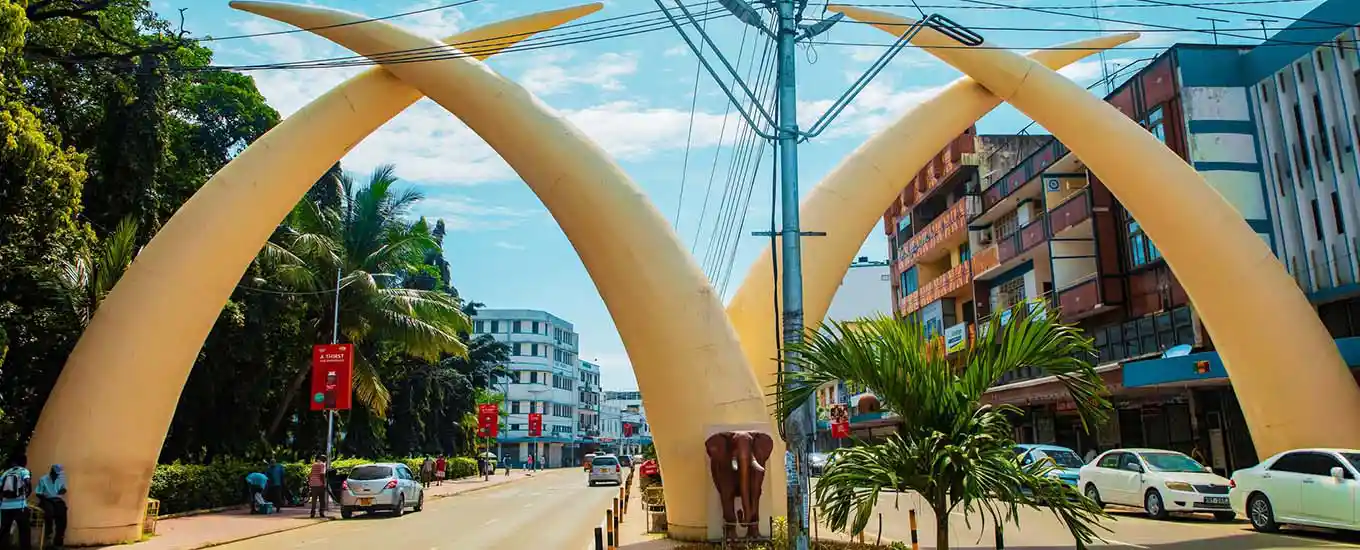
The Old Town of Mombasa sits at the eastern, ocean-facing tip of Mombasa Island. To the south, the island is separated from mainland Kenya by Kilindini and Port Reitz, a modern deep-water harbour and port. On the northern side, the old harbour called Port Tudor and Tudor Creek, both watched over by Fort Jesus, divide the island from the mainland. Today, the rest of the island is filled with modern residential neighbourhoods and industrial zones.
Mombasa Island is connected to the mainland by the Makupa Causeway in the northwest, the Nyali Bridge in the east, and the Likoni Ferry in the south. There’s also a road and rail bridge serving the mainland’s container port near Port Reitz.
Port Tudor and Tudor Creek were named after Royal Navy captain Owen Tudor, who was the first to map the area. Mombasa Island is one of the divisions of Mombasa County. According to the census held in 2019, the division has a population of 1,208,333.
Detailed info on Mombasa
Mombasa is a coastal city located in south-eastern Kenya along the Indian Ocean. It was the original capital of British East Africa before Nairobi took over that role in 1907. Today, it serves as the capital of Mombasa County and is often referred to as “the white and blue city.” With roots dating back to around 900 A.D., Mombasa is the oldest and second-largest city in Kenya after Nairobi, with a population of about 1.2 million according to the 2019 census.
Thanks to its coastal location, Mombasa has long been a significant hub for trade. Its strategic position has attracted the control of various foreign powers over the centuries. Historical accounts, including those in Kenyan school textbooks, date the city’s founding to around 900 A.D. By the 12th century, Mombasa had already grown into a thriving trading centre, as noted by Arab geographer al-Idrisi in 1151. It became part of the Kilwa Sultanate in the early 14th century and remained under its influence until around 1513. Notable religious landmarks include the Mnara Mosque, built around 1300, and the Mandhry Mosque, constructed in 1570, which features a distinct ogee-arched minaret.
During the late pre-colonial era, Mombasa developed into a major urban centre within a plantation-based economy that relied heavily on enslaved labour. The city played a vital role in Indian Ocean trade networks, exporting goods like ivory, millet, sesame, and coconuts.
In modern times, Mombasa is a key destination for tourism. It hosts one of Kenya’s state houses, has a major seaport, and is served by an international airport.
Mombasa and the Kenyan coastline is known for beautiful beaches, with activities down along the coast.
MOMBASA MAINLAND
PHYSICAL FEATURES OF MOMBASA
Mombasa’s physical features are shaped by its coastal location and coral-based landscape. The city is centred on Mombasa Island, a low-lying coral outcrop about 5 km long and 3 km wide, surrounded by the Indian Ocean and natural tidal creeks. To the north lies Tudor Creek, while Kilindini Harbour is to the south, both of which separate the island from the mainland and serve as important maritime routes.
The coastline is marked by sandy beaches, coral reefs, and mangrove swamps, which support diverse marine life and protect against coastal erosion. The terrain is mostly flat with a low elevation, making some areas prone to flooding. Mombasa’s base is largely made of coral limestone, influencing the type of vegetation and soil found in the area. While the natural environment is prominent, much of the land is now urbanised with roads, ports, bridges, and residential developments, especially as the city continues to grow onto the surrounding mainland.
CLIMATE
Mombasa experiences a tropical wet and dry climate. Rainfall levels vary with the seasons, with the heaviest rains typically occurring in April and May, and the driest period falling between January and February. Because the city is near the equator, temperatures remain fairly consistent throughout the year, generally ranging from 28.8°C to 33.7°C (83.8°F to 92.7°F).
As a coastal port city, Mombasa faces serious impacts from climate variability. In October 2006, for example, the city suffered severe flooding that affected around 60,000 residents.
Climate change poses increasing challenges for Mombasa, much like the rest of Kenya. Coastal erosion, driven by rising sea levels, has become a significant issue, threatening infrastructure. The shoreline is eroding at a rate of 2.5 to 20 centimetres (0.98 to 7.87 inches) each year, which has led to more frequent flooding events.
ETHNIC GROUPS
Mombasa is home to a wide mix of ethnic groups, a reflection of its coastal location and long history as a centre of trade. Among the main local communities are the Mijikenda, Swahili, and Kenyan Arabs. The Mijikenda form the largest ethnic group in Mombasa County, accounting for about 35% of the population. The Kamba, who migrated to the area, are the second largest group, making up around 30% of the population. Other notable communities in the county include the Luo, Luhya, and Somali.
There are also non-indigenous ethnic minorities in Mombasa, such as the Arabs and Asians. Most Kenyan Arabs live in the Coast region, with over half residing in Mombasa. Nearly all of them hold Kenyan citizenship, speak Swahili instead of Arabic, and identify as Africans. A small number of non-Kenyan Arabs, mostly traders from Yemen, are known as Shihiri. Mombasa also has a mixed-race population, including descendants of Kenyan Asians, many of whom have become part of the local culture
MOMBASA BEACHES
- Diani Beach
- Nyali Beach
- Tiwi Beach
- Bamburi
- Shelly Beach
- Jomo Kenyatta Beach
- Shanzu Beach
- Mombasa Beach
- Galu Kiondo Beach
- Copa Cabana Beach (Mtwapa)
ACTIVITIES AROUND MOMBASA:
- Old Town Mombasa Tour and Fort Jesus
- Dolphin Watch & Snorkelling at Kisite Marine Park & Wasini Island
- Watamu Marine Park & Sudi Island Mangrove Forest Canoe trip
- Shimba Hills
- Haller Park
- Nguuni Nature Sanctuary
- Wild Waters
- Mamba Village Centre
- Mombasa Marine National Park
- Jumba La Mtwana
- Avicennia Island
- Funzi Island
- Bombolulu Workshop & Cultural Centre.