
Nairobi City
Explore Nairobi City: Travel, Culture, and Wildlife in the Kenyan Capital
Nairobi, the Kenya capital city, is the largest city in the country and serves as the political, economic, and cultural hub of Kenya. Founded in 1899 as a railway depot on the Kenya-Uganda railway, it quickly grew into a strategic commercial center due to its central location. Today, Nairobi covers an area of approximately 696 km² and has a population exceeding 5.7 million people as of 2024. Nairobi serves as the leading financial and economic center of East Africa, accommodating a wide range of multinational corporations and regional institutions, including the United Nations Office at Nairobi. Known as the “Green City in the Sun,” and the “Safari capital of the world” it is the only capital in the world with a national park within its city limits. The name Nairobi comes from the Maasai phrase Enkare Nyirobi, which translates to “place of cool waters.”
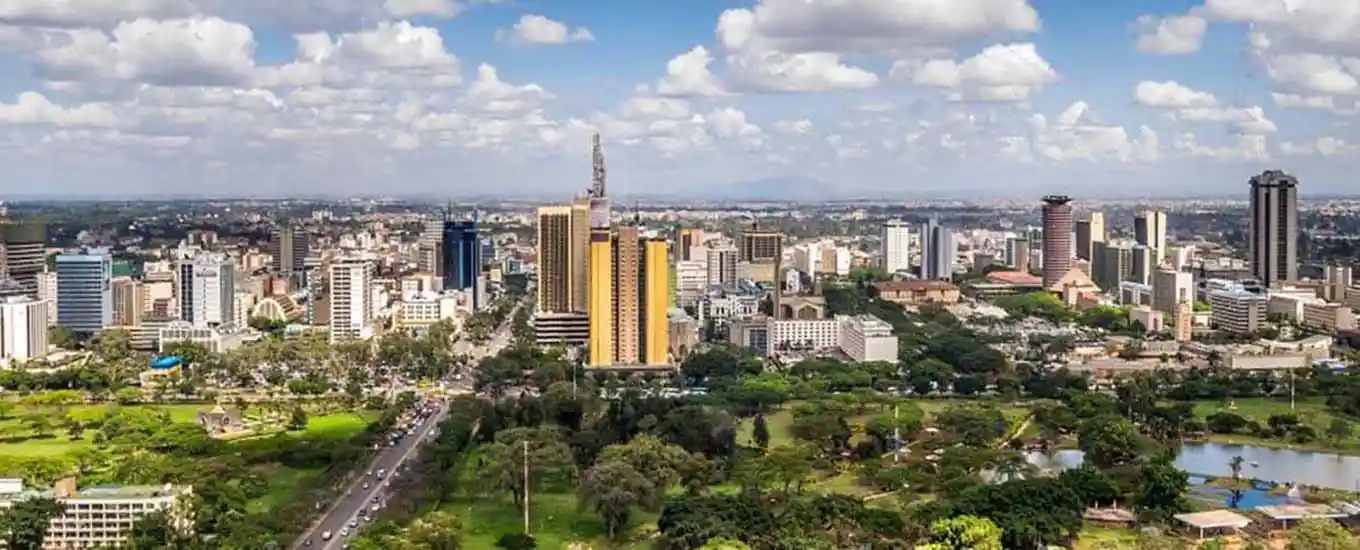
Nairobi, the capital city of Kenya, has seen major infrastructure developments in recent years to improve transport and urban living. The Nairobi Expressway, completed in 2022, eases traffic on Mombasa Road and provides faster links between the city center and southern suburbs. In 2021, the Green Park Bus Terminal was opened to enhance public transport and streamline commuter traffic.
The city has also added housing projects through the government’s Affordable Housing Program, meeting the needs of a growing population. Modern residential and mixed-use projects are reshaping the skyline, fueling urban growth and boosting Nairobi’s appeal to both residents and tourists. These upgrades, together with Nairobi’s cultural and natural attractions, strengthen tourism and make the city a more accessible hub for business and leisure.
Detailed Information on Nairobi
Early History and Founding of Nairobi
The area where Nairobi now stands was originally swampy land inhabited by the Maasai, who were primarily pastoralists, the Akamba traders who engaged in long-distance commerce, and the Kikuyu people, known for their farming practices. The name Nairobi is derived from a Maasai expression meaning “cool waters,” a reference to the cold streams that ran through the area. The site gained prominence with the construction of the Uganda Railway, when Sir George Whitehouse identified it as an ideal location for a store depot, a shunting ground, and a resting place for the Indian laborers working on the railway.
Whitehouse, the chief engineer of the railway, valued the site for its high elevation, temperate climate, reliable water sources, and convenient position before the steep ascent of the Limuru escarpments. Some colonial officials initially criticized the selection, describing the land as too flat, poorly drained, and relatively infertile. Nevertheless, the decision laid the foundation for the future Kenya capital city.
Colonial Growth and Urban Planning
Before colonial rule, communities lived in villages with tribal leadership. However, in 1898, Arthur Church designed Nairobi’s first official layout. His plan featured two main streets, Victoria and Station, together with ten avenues, staff housing, and a commercial zone dominated by Indian traders.
When the railway reached Nairobi on May 30, 1899, the town quickly replaced Machakos as the administrative center of Ukamba province. Whitehouse predicted rapid growth, and within two years, land applications surged. Despite this enthusiasm, the town struggled with malaria outbreaks, leading to proposals to relocate the settlement. Nevertheless, after a plague and the destruction of Bazaar Street (now Biashara Street), the area was rebuilt. This demonstrated Nairobi’s resilience and its commitment to urban progress.
Population Growth and Tourism (1900s–1920s)
Between 1902 and 1910, Nairobi’s population increased from around 5,000 to 16,000, with growth driven by administration, commerce, and tourism, particularly big game hunting in the surrounding areas. In 1907, Nairobi was designated the capital of the East Africa Protectorate, replacing Mombasa, and by 1919, the town had been declared a municipality. These formative years established Nairobi not only as a political and administrative hub but also as a center for early Nairobi tourism, attracting visitors intrigued by the region’s natural beauty and
Physical Features of Nairobi
Nairobi lies between Kampala and Mombasa, close to the eastern edge of the Great Rift Valley. Consequently, its location makes it prone to minor earthquakes and tremors. To the west, the Ngong Hills stand out as a prominent landmark. Meanwhile, Mount Kenya rises to the north, while Mount Kilimanjaro is visible to the southeast.
The Nairobi River and its tributaries flow through the county, eventually joining the Athi River to the east. The city spans about 20 kilometers—from Kenyatta National Hospital in the south to the UN headquarters in Gigiri, in the north.
At the center lies City Square, surrounded by major landmarks. These include the Kenyan Parliament, Holy Family Cathedral, Nairobi City Hall, Law Courts, and the Kenyatta International Convention Centre. Together, they form the core of Nairobi’s tourism and administrative activity.
Nairobi Climate
Nairobi enjoys a subtropical highland climate, with moderate temperatures year-round. Because of its elevation, 1,795 meters (5,889 feet) above sea level, the city often experiences cool evenings, especially in June and July, when temperatures can drop to 9 °C (48 °F).
The warmest months fall between December and March, with highs of up to 28 °C (82 °F). Rainfall remains moderate, while the cloudiest period comes after the first rainy season. Overcast skies and light drizzle often persist until September. Thanks to its equatorial location, Nairobi has minimal seasonal variation. Sunrise and sunset times remain consistent, making the climate predictable and appealing to tourists.
Ethnic Diversity in Nairobi
Nairobi is Kenya’s most ethnically diverse city. It is home to communities such as the Kikuyu, Luo, Luhya, Kamba, and Kisii. Each group contributes uniquely to the city’s cultural and economic life. The Kikuyu are especially active in business and agriculture. Meanwhile, the Luo and Luhya thrive in trade, education, and professional sectors. Kamba communities are recognized for their entrepreneurship, while the Kisii play a central role in commerce and industry.
In addition, the Maasai and Somali communities enrich Nairobi’s cultural landscape through fashion, crafts, and tourism. The city also attracts a large expatriate population from Europe, Asia, and across Africa, enhancing its cosmopolitan identity. This diversity is evident in languages, Swahili and English are widely spoken, as well as in cuisine, music, festivals, and religious practices. For visitors, this multicultural environment elevates Nairobi tourism, offering authentic cultural experiences alongside modern amenities.
ACTIVITIES AROUND NAIROBI:
- Nairobi National Park safari and wildlife viewing
- Visiting the David Sheldrick Wildlife Trust for orphaned elephants
- Close encounters with giraffes at the Giraffe Centre in Karen
- Walking through the Nairobi Safari Walk and Animal Orphanage
- Hiking, jogging, or cycling in Karura Forest
- Exploring the Nairobi Arboretum for nature walks and birdwatching
- Cultural performances and exhibits at Bomas of Kenya
- Touring the Karen Blixen Museum
- Shopping for crafts and souvenirs at Maasai Markets
- Exploring Kenya’s heritage at the Nairobi National Museum
- Visiting Kazuri Beads for artisan pottery and beadwork