Tanzania Travel Guide
Tanzania is an East African country located just south of the Equator, formed in 1964 through the union of Tanganyika and Zanzibar. The mainland, Tanganyika, makes up more than 99% of the total territory, while Zanzibar and Pemba islands maintain a semi-autonomous government. Dodoma serves as the official capital, centrally located on the mainland, whereas Dar es Salaam remains the largest city and the primary port. Known for its natural wonders, diverse cultures, and safari destinations, this East African nation offers travelers a unique blend of adventure and cultural experiences.
Zanzibar and Pemba
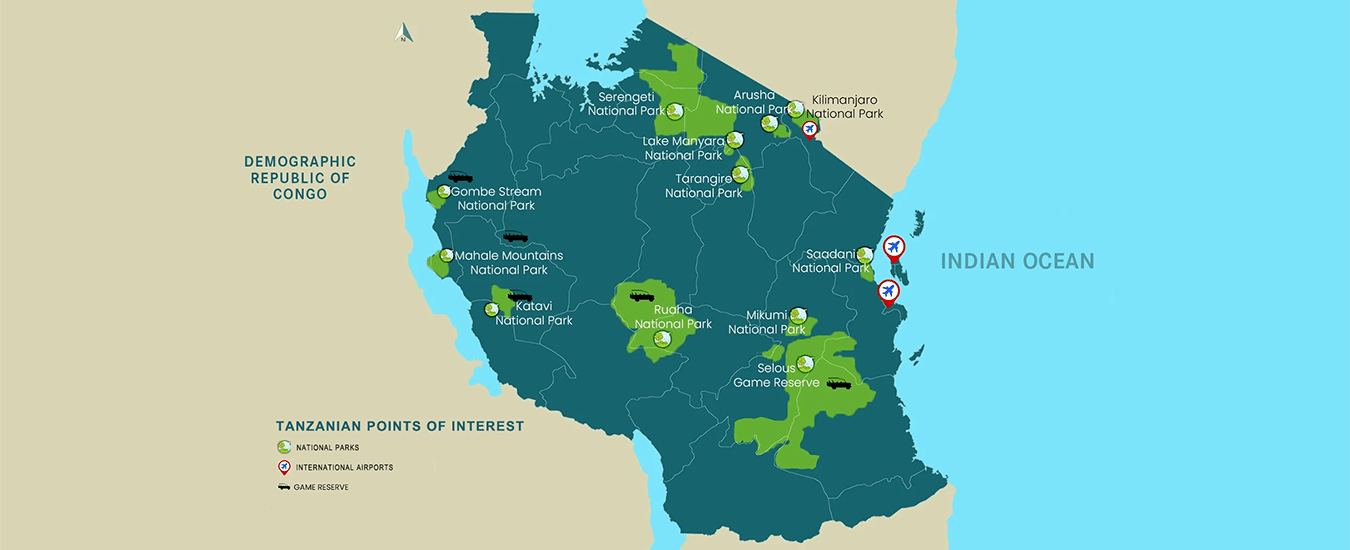
Zanzibar and Pemba lie in the Indian Ocean, with Zanzibar situated about 35 km (22 miles) from the mainland and Pemba approximately 56 km (35 miles) away. Both islands consist mainly of coralline rock formations. Zanzibar’s western and northwestern regions feature ridges above 60 meters, while most of the southern and eastern areas are low-lying. Pemba appears hilly due to gullied central ridges, and streams drain into numerous creeks. On Zanzibar, short streams mostly flow north and west, with eastern streams disappearing into porous rock. These islands are renowned for their beaches, historical Stone Town, spice plantations, and vibrant cultural heritage, making them essential stops for travelers.
Mainland Tanzania
The mainland borders Uganda, Kenya, and Lake Victoria to the north; the Indian Ocean to the east; Mozambique, Malawi, Zambia, and Lake Nyasa to the south; and Lake Tanganyika, Rwanda, and Burundi to the west. Most of the mainland lies above 200 meters, with vast plains and plateaus contrasting with dramatic landscapes, including Africa’s highest peak, Mount Kilimanjaro (5,895 meters), and the second-deepest lake, Tanganyika (1,436 meters).
The East African Rift System splits the mainland into two north-south branches, creating deep depressions filled by lakes. The Western Rift Valley, along the western frontier, includes Lakes Tanganyika and Rukwa, while the Eastern Rift Valley runs from northern lakes such as Eyasi, Manyara, and Natron south to Lake Nyasa. Between these branches lies the central plateau, covering over a third of the country.
Highlands along the Western Rift include the Ufipa Plateau, Mbeya Range, and Rungwe Mountains. From the southern highlands, the terrain extends northeast along the Great Rift to the Ukuguru and Nguru mountains. Northern mountain chains, such as Usambara and Pare, culminate at Kilimanjaro and Mount Meru (4,565 meters). West of Meru, Ol Doinyo Lengai, an active volcano, and the Ngorongoro Crater, the world’s largest caldera, dominate the landscape.
Tanzania has over 59,000 square km of inland water, including Lake Victoria, Lake Nyasa, and Lake Tanganyika. Although the country lacks major rivers, it forms the headwaters for the Nile, Congo, and Zambezi rivers. The Ruvuma, Rufiji, Wami, and Pangani rivers flow into the Indian Ocean, with Rufiji covering much of southern mainland. Rivers and lakes provide substantial hydroelectric potential, supporting development and agriculture.
Climate
The climate varies with elevation and geography, creating four main zones: the hot, humid coastal lowlands; the arid central plateau; the northern highlands around Kilimanjaro; and highlands in the northeast and southwest. Temperatures fluctuate little, with solar radiation remaining strong throughout the year. Frosts are rare below 2,500 meters.
Rainfall is seasonal, driven by the intertropical convergence zone. Approximately half of the mainland receives less than 750 mm annually. The central plateau is the driest, with less than 510 mm per year and a single rainy season from December to May. Coastal regions experience two rainfall peaks (October–November and April–May), while islands and highlands receive over 1,520 mm annually.
Vegetation varies with rainfall. High-precipitation highlands support forests, while western and southern plateaus feature miombo woodland. Arid zones contain bushland and thickets. Floodplains sustain wooded grasslands, and poorly drained areas produce swamps. The Serengeti plains owe their grasslands to calcium-rich calcrete near the surface. Alpine and saline deserts appear in high elevations and arid regions.
Ethnic Groups
Tanzania hosts more than 130 indigenous ethnic groups, many clustered into larger communities. Early inhabitants include San-type hunters; the Sandawe are believed to be their descendants. Cushitic migrants from Ethiopia introduced agriculture and pastoralism around 1000 BCE. Around 500 CE, Bantu farmers migrated from the west and south, absorbing or displacing earlier inhabitants. Nilotic pastoralists arrived from southern Sudan around the same period.
No single ethnic group dominates politically or culturally, although groups influenced by missionary work and colonial education, such as the Chaga and Haya, are well represented in governance and the cash economy.
Religiously, approximately 62% of Tanzanians are Christian, 33% are Muslim, and the remainder follow traditional beliefs. In rural areas, indigenous practices often blend with formal religions, reflecting a diverse spiritual landscape.
Details about Tanzania
| Head Of State And Government | President: Samia Suluhu Hassan |
| Capital | Dodoma |
| Population | (2025 est.) 67,529,000 |
| Form Of Government | Unitary multiparty republic with one legislative house (National Assembly) |
| Official Languages | Swahili; English |
| Official Religion | None |
| Total Area (Sq Km) | 945,500 |
| Total Area (Sq Mi) | 365,058 |
| Monetary Unit | Tanzanian shilling (TZS) You can not use foreign Currency in Tanzania. See more under FAQ |
| Population Rank | (2025) 21 |
| Population Projection 2030 | 71,992,000 |
| Density: | Persons Per Sq Mi (2025) 185 |
| Density: | Persons Per Sq Km (2025) 71.4 |
| Urban-Rural Population | Urban: (2022) 34.9% • Rural: (2022) 65.1% |
| Life Expectancy At Birth | Male: (2021) 63.7 years • Female: (2021) 69 years |
| Literacy: Percentage Of Population Age 15 And Over Literate | Male: (2022) 86% • Female: (2022) 79% |
| Gni Per Capita (U.S.$) | (2023) 1,220 |
Fun Facts
Tanzania experiences some of the most luminescent moons in the world, often so bright that flashlights are not necessary for people to see at night.
Tanzania has the largest animal population density out of any country in the world. That is, there are more animals per square mile of land in Tanzania than in any other country.
MUST SEE:
Serengeti National Park
Mount Kilimanjaro national Park
Empakaai Crater
Lake Manyara Treetop Walkway
Ngorongoro Conservation Area & Crater
Ol Doinyo Lengai
Sources partly from: https://en.wikipedia.org/wiki/Tanzania, https://www.britannica.com/place/Tanzania